Credit every install to the touchpoint that earned it
AppVero combines the Google Play and Meta install referrers, Apple Ads, device-ID and view-through matching into one engine — with windows you control, reinstall detection and an honest answer for iOS users who haven’t consented.
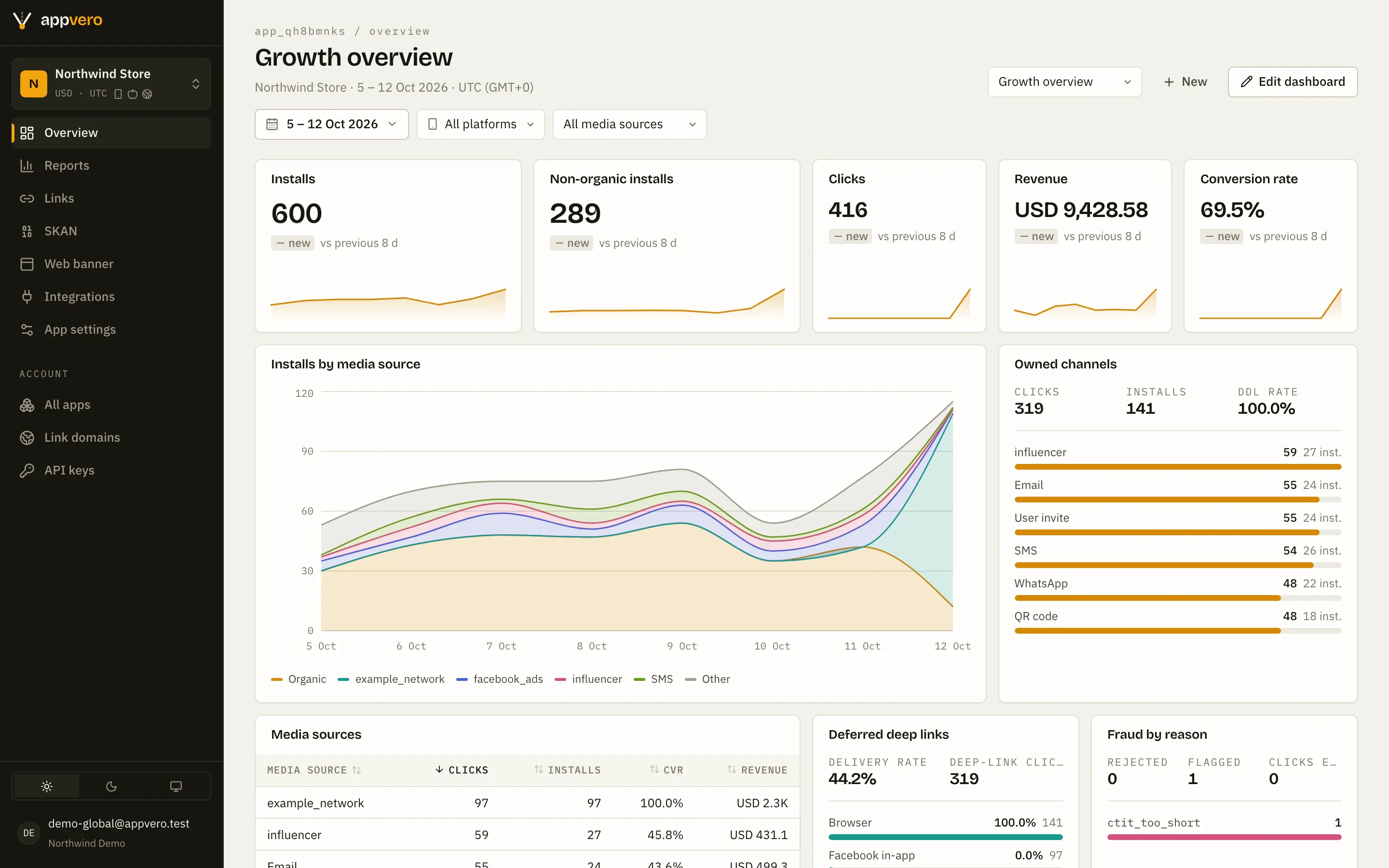
Attribution: what’s included
Google Play Install Referrer
The click ID travels through the Play Store referrer, so Android installs attribute deterministically — even if a click row is lost.
Meta Install Referrer
Read on device from the Facebook, Instagram and Facebook Lite providers and decrypted server-side with your app’s Meta key.
Apple Ads (AdServices)
The AdServices token is resolved with Apple’s API for click and view-through attribution of Apple Ads campaigns.
Device-ID matching
GAID and consented IDFA from ad-network click macros. Impression links add view-through matching.
Owned-media matching
Probabilistic matching is for your own links and QR codes, with a short window — never the default for paid media.
Reinstalls & re-attribution
An install registry recognises returning devices, and re-engaged users can be re-attributed after a period of inactivity.
Deterministic first. Then honest about the rest.
At first launch the SDK sends the install with every signal it collected, and AppVero returns the attribution — and any deferred deep link — in the same response. Last touch wins, and clicks beat impressions.
Android
- 1Play Install ReferrerClick ID carried through the Play Store referrer
referrer - 2Meta Install ReferrerDecrypted with the app’s Meta key
meta_referrer - 3Device-ID clickGAID from the ad network’s click macros
device_id - 4Device-ID impressionGAID from an impression link
view_through - 5Owned media onlyShort-window probabilistic match on your own links
probabilistic - –Nothing matchedThe install is organic
organic
iOS
- 1Apple AdsAdServices token, click and view-through
apple_ads - 2Device-ID clickIDFA, only when ATT is authorised
device_id - 3Owned media onlyShort-window probabilistic match on your own links
probabilistic - !No consentPaid media without ATT consent → restricted, measured in aggregate via SKAN / AdAttributionKit
restricted - –Nothing matchedThe install is organic
organic
Lookback windows, per app
Every app has its own attribution settings. These are the defaults for a new app.
| Setting | Default | What it does |
|---|---|---|
| Click window | 7 days | How far back a click can be credited for an install. |
| View window | 24 hours | How far back an impression (view-through) can be credited. |
| Probabilistic window | 6 hours | Short window for owned-media matching when there is no deterministic signal. |
| Probabilistic scope | owned_media | Which media can use probabilistic matching: owned media, all, or off. |
| Re-attribution inactivity | 7 days | How long a user must be inactive before a new engagement can re-attribute them. |
| Re-attribution window | 30 days | How recent that new engagement must be. |
Reports in your timezone, revenue in your currency
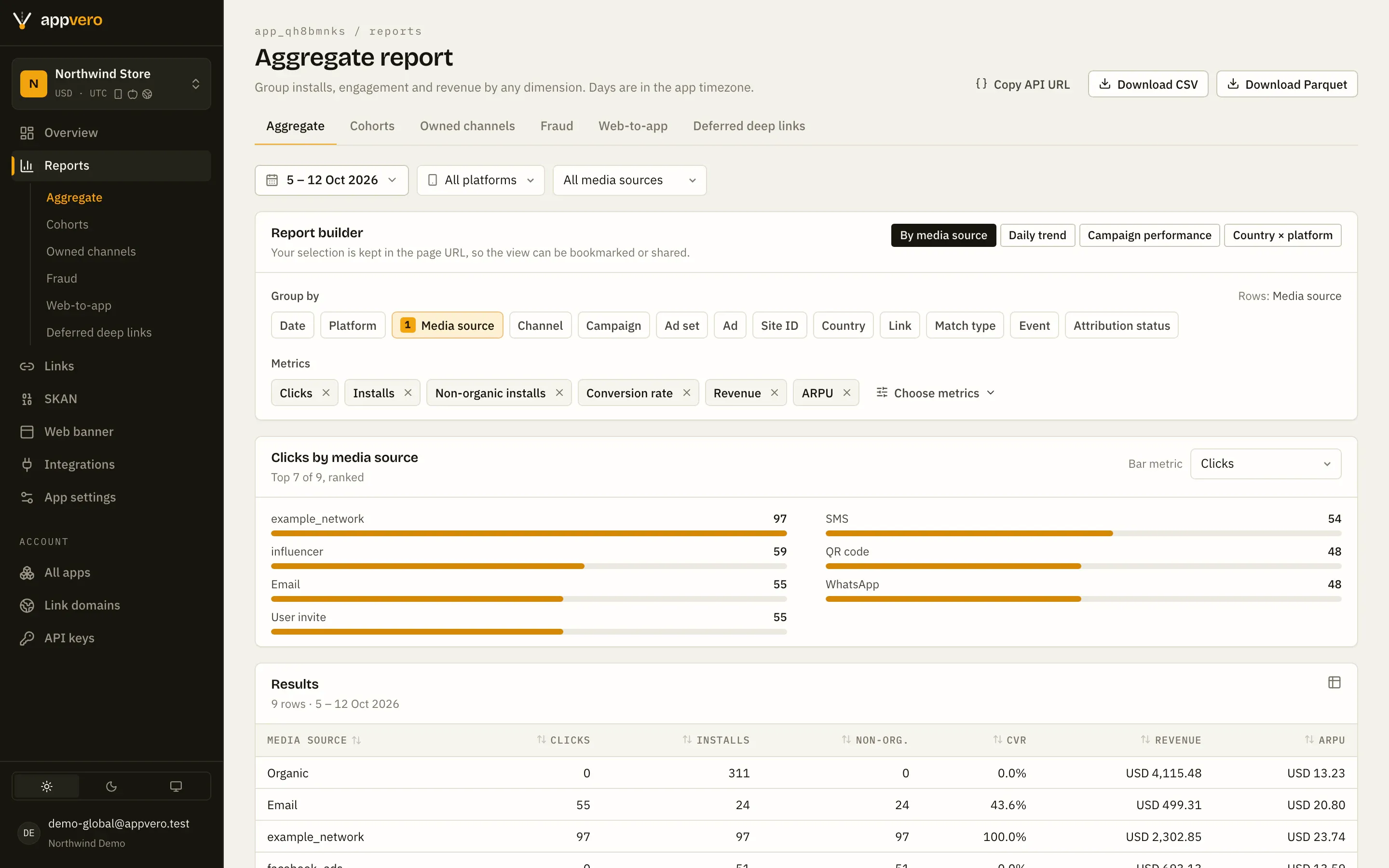
Slice installs, events and revenue by date, platform, media source, channel, campaign, ad set, ad, site ID, country, link, match type and more. Days end at midnight in your app’s timezone, and revenue is normalised to your reporting currency with daily ECB reference rates (30+ currencies).
- Cohort reports for retention, revenue and events
- Owned-channel report from click to deep-link open
- Download any view as CSV or Parquet
Events from your backend count too
Send orders, KYC approvals or renewals from your servers with an s2s-scoped API key. Identify the user by install ID, customer user ID, GAID or IDFV, and the events inherit the install’s attribution — just like SDK events.
curl -X POST https://api.appvero.ai/v1/s2s/events \
  -H "Authorization: Bearer avk_<id>_<secret>" \
  -H "Content-Type: application/json" \
  -d '{
    "customer_user_id": "u_123",
    "events": [{
      "event_id": "5b6c1d2e-8f90-4a1b-9c3d-2e4f6a8b0c1d",
      "name": "av_purchase",
      "ts": 1760003700000,
      "revenue": 49.90,
      "currency": "USD",
      "params": { "order_id": "NW-10293" }
    }]
}'Does AppVero fingerprint iOS users who declined tracking?
No. Installs from paid media without ATT consent are marked restricted and measured in aggregate through SKAdNetwork and AdAttributionKit. Probabilistic matching is limited to your own media and is never the default for paid media.
Which attribution model do you use?
Last touch. Clicks beat impressions, and deterministic signals (Play referrer, Meta referrer, Apple Ads, device IDs) are tried before probabilistic matching.
Can I attribute events that happen on my server?
Yes — the S2S events API accepts the same event format as the SDKs, authenticated with an s2s-scoped API key.
More of the platform
- Deep linkingShort links, QR and deferred deep links that survive in-app browsers.
- Web-to-appSmart banners and a smart script that carry ad clicks into the app.
- iOS privacySKAdNetwork 4, AdAttributionKit and ATT, measured honestly.
- Fraud protectionSigned SDK traffic and public reason codes. Included.
- Raw data & APIsHourly Parquet to your warehouse, webhooks and APIs.
See your own data in AppVero
Bring a campaign, a link or an app build. We’ll walk through attribution, deep links and raw data with your team, on data that looks like yours.